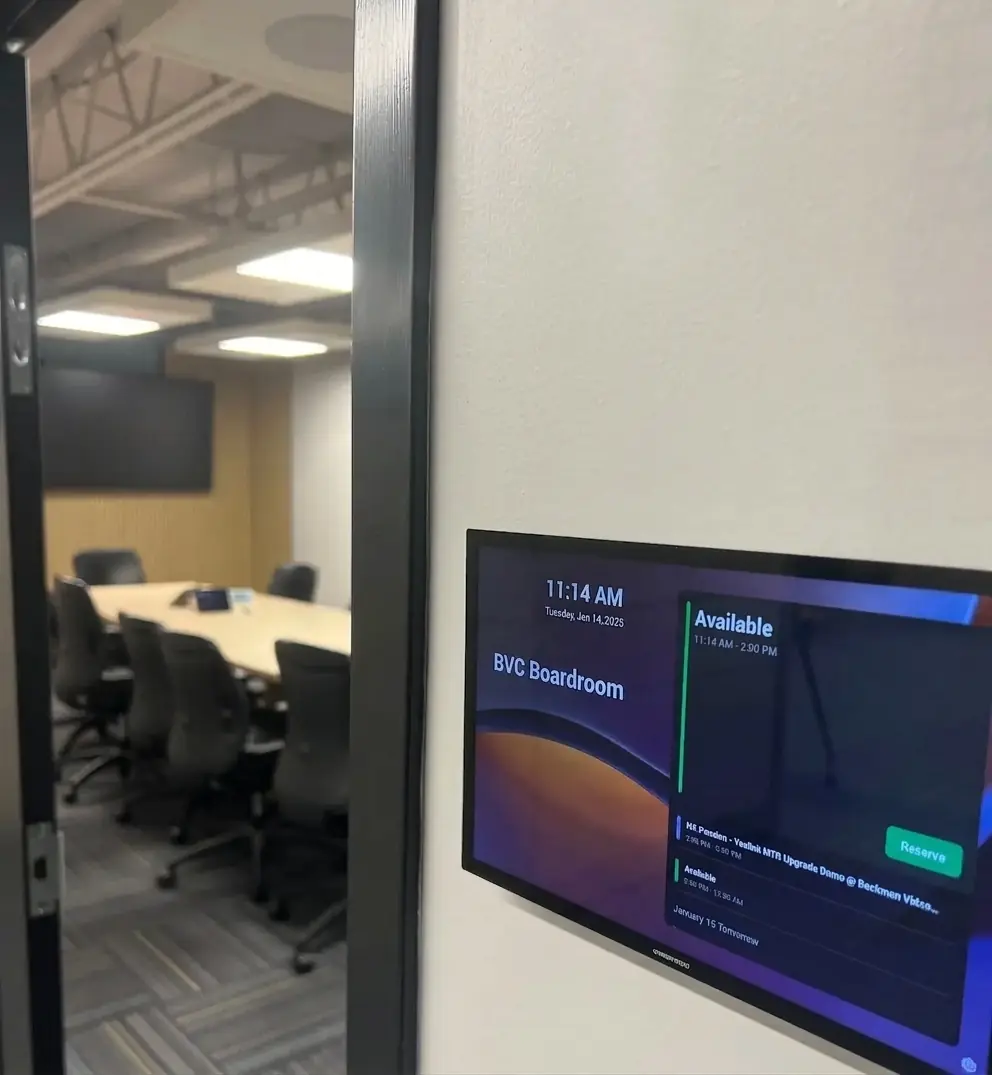
Today’s workplaces often feature open-concept layouts, glass-walled meeting rooms, and shared spaces that encourage flexibility and collaboration. These designs look great and promote interaction, but they can also introduce unintended acoustic problems: excessive noise, distracting echoes, and a lack of speech privacy that disrupt concentration, reduce productivity, and frustrate both in-person and remote participants.
As a commercial AudioVisual equipment supplier and integrator, Backman Vidcom understands that outstanding AudioVisual systems depend not only on what is seen, but on what is heard, and how clearly. Sound masking and acoustic panels are two of the most effective tools for fixing a noisy space. Here is how they work, and how they work together.
TL;DR
- Open-plan offices, glass walls, and hard surfaces cause noise, echo, and poor speech privacy.
- Acoustics is the foundation – how sound behaves in a space determines how well people can focus and communicate.
- Sound masking adds a low, engineered background sound that makes nearby conversations less intelligible and less distracting.
- Acoustic panels absorb sound to reduce echo and reverberation, and can be designed to match or enhance any interior.
- The best results combine all three, tailored to how the space is actually used, which is where an experienced AudioVisual integrator adds value.
Why Do Modern Offices Have Acoustic Problems?
Acoustics play a crucial role in how a space feels and functions. In environments where people need to focus, present ideas, or join virtual meetings, poor sound quality is more than a nuisance – it creates communication breakdowns and a sense of discomfort. Echoes bouncing off hard surfaces and unintelligible speech in open areas are common issues in modern offices built with glass, concrete, and open floor plans.
Hybrid work adds to the challenge. Fluctuating occupancy means fewer people in the room to absorb ambient sound, so spaces can feel louder and more distracting than ever. That is why acoustical planning should be an essential part of workplace design, not an afterthought.
What Is Sound Masking and How Does It Work?
Sound masking is one of the most effective ways to improve comfort and speech privacy. It works by introducing a low-level ambient background sound, often engineered to resemble airflow or gentle white noise, through small ceiling-mounted speakers.
This sound reduces how far conversations carry and makes them less intelligible to others. Rather than eliminating noise, sound masking blends it into a more comfortable, less distracting audio environment. It is especially useful in open work areas, healthcare settings, banks, and call centres, where both privacy and productivity are priorities.
Placement matters. Sound masking works best in the open areas around meeting rooms, not inside them, since the background sound can otherwise be picked up by videoconferencing systems. The rule of thumb: put sound masking where the listener is, not where the sound is coming from.

What Are Acoustic Panels and Where Are They Used?
Acoustic panels absorb sound to reduce reverberation and control echo. They can be installed on walls, ceilings, or suspended as clouds, and they come in a wide range of materials and finishes to match any interior design:
- Fabric-wrapped panels offer a clean, professional look
- Felt panels made from recycled PET materials provide sustainable options
- Printed panels can carry custom graphics or branding to double as decorative art
- Wooden slat panels add a modern architectural touch
With the right design, acoustic treatments become part of the visual identity of your workplace rather than something to hide.
How Backman Vidcom Approaches Acoustics
At Backman Vidcom, we approach acoustics with an integrative mindset. A common example is a glass-walled conference room where clients cannot hear remote participants clearly because of echo. Combining a sound masking system with customized ceiling treatments creates a more balanced, functional space for collaboration and presentations.
This is the kind of work that shows our ability to design and implement complete AudioVisual environments where technology, layout, and acoustics work together seamlessly.
Why Acoustics Matter More in Hybrid Workplaces
As hybrid work becomes more common, audio quality is no longer just a technical consideration – it is a key part of the employee experience. Whether in a boardroom, huddle space, or open office area, poor sound affects how people feel and perform. A thoughtful acoustic strategy that combines sound masking, acoustic treatments, and precise equipment placement ensures that everyone, in the room and on the call, can participate with confidence.
Frequently Asked Questions
What is the difference between sound masking and acoustic panels? Sound masking adds a low background sound that makes nearby speech less intelligible, improving privacy and reducing distraction. Acoustic panels absorb sound to reduce echo and reverberation. Sound masking covers noise; panels remove it. Most spaces benefit from both.
Does sound masking just add more noise? No. Sound masking adds a carefully calibrated, low-level ambient sound that the brain quickly tunes out. Rather than making a space louder, it makes distracting conversations blend into the background, so people notice them less.
Where is sound masking most useful? Open-plan offices, healthcare settings, banks, call centres, and any space where speech privacy and concentration matter. It is most effective in the open areas around meeting rooms rather than inside them.
Can acoustic panels look good, not just work well? Yes. Acoustic panels come in fabric, felt, printed graphics, and wooden slat finishes, and can be designed to match or enhance your interior. Many double as decorative or branded features.
How do I know what my space needs? It depends on the room, its surfaces, and how it is used. An acoustic assessment identifies whether you need absorption, sound masking, better equipment placement, or a combination. Backman Vidcom can assess your space and recommend the right approach.
Improve the Sound of Your Workplace
If your workplace is too noisy, suffers from echoes, or lacks speech privacy, Backman Vidcom can help. Contact us today to explore how sound masking and acoustic panels can improve your space and create a more productive, comfortable, and professional environment, or call 902-450-5005.